
Understanding and Mitigating Volt Typhoon Attacks

Understanding and Mitigating Volt Typhoon Attacks

What Are Volt Typhoon Attacks?

Imagine a cyber threat so sophisticated that it can move through your digital infrastructure like a ghost, leaving virtually no trace. This is the reality of Volt Typhoon—a state-sponsored cyber threat that represents the cutting edge of digital warfare. At its core, Volt Typhoon is more than just a hacking group; it's a highly organised, strategically driven cyber operation originating from the People's Republic of China. Unlike typical cybercriminals who seek quick financial gains, these attackers are playing a long-term, strategic game of digital infiltration and intelligence gathering.

The Art of Digital Camouflage

Think of Volt Typhoon's approach like an elite special forces team entering a secure facility. They don't break down doors or set off alarms—instead, they blend in perfectly, using the facility's own systems and protocols against it. In the digital world, this means leveraging legitimate system tools to move undetected. Their primary infiltration technique, known as "Living off the Land" (LotL), is particularly ingenious. By using built-in Windows utilities like PowerShell and Windows Management Instrumentation (WMI), they can execute complex operations that look exactly like routine administrative tasks. It's like a master forger creating documents so perfect that they're indistinguishable from the originals.

Precision Targeting

Volt Typhoon doesn't cast a wide, indiscriminate net. Instead, they meticulously select and probe specific targets, with a particular focus on critical infrastructure. Their preferred entry points include:

Virtual Private Networks (VPNs)

Imagine a secure, private tunnel through a busy, public highway. That's essentially what a Virtual Private Network (VPN) does in the digital world. A VPN creates an encrypted connection between your device and a remote server, effectively creating a secure, private pathway across the public internet. It's like having a personal, invisible car that travels through crowded streets without anyone being able to see inside or know its contents. Key Functions:

  • Encrypts all internet traffic
  • Masks your actual physical location
  • Allows secure remote access to private networks
  • Protects data from potential interceptors

Firewall Systems

A firewall is essentially the security checkpoint of your network—a digital bouncer that decides who gets in and who stays out. Firewalls monitor incoming and outgoing network traffic, using predetermined security rules to allow or block specific data packets. They act as a barrier between trusted internal networks and untrusted external networks, like the internet. Key Functions:

  • Filters network traffic based on security rules
  • Blocks potential malicious incoming connections
  • Prevents unauthorised access to private networks
  • Logs and reports suspicious activities

Network Routers

A router is the postal service of the digital world—it directs data packets to their correct destination across complex network landscapes. Routers connect different computer networks, forwarding data packets between them. They determine the most efficient path for data to travel, ensuring information reaches its intended destination quickly and accurately. Key Functions:

  • Connect different network segments
  • Direct data traffic between networks
  • Translate between different network protocols
  • Provide basic network security features

Public-Facing Network Appliances

Public-facing network appliances are like the front desk of a digital organisation—they're the first point of contact for external connections and services. These are network devices directly exposed to the internet, providing services or access points for external users. They're critical infrastructure components but also potential vulnerability points. Examples Include:

  • Web servers
  • Email servers
  • VPN concentrators
  • Load balancers
  • DNS servers

Key Characteristics:

  • Directly accessible from the internet
  • Provide specific network services
  • Require robust security measures
  • Potential entry points for cyber attacks

Real-World Analogy: Imagine these as the reception areas of large, secure complexes. They're designed to provide necessary services to visitors while maintaining strict security protocols to prevent unauthorised access to inner areas. Each of these represents a potential gateway into an organisation's most sensitive digital environments.

Why Volt Typhoon Attacks Are a Critical Concern

Understanding the potential impact of a Volt Typhoon attack is crucial. These aren't just technical intrusions—they're strategic operations with potentially devastating consequences.

The Multidimensional Threat Landscape

Consider each risk as a domino in a complex chain reaction. When one falls, it triggers a cascade of potential organisational challenges:

1. Intellectual Property Theft

Imagine years of research, innovative designs, and competitive strategies simply vanishing overnight. Intellectual property theft isn't just about immediate financial loss—it's about undermining an organisation's entire future potential. A single breach could compromise decades of strategic development, rendering years of investment essentially worthless.

2. Financial Vulnerabilities

When a sophisticated cyber attack like a Volt Typhoon incursion occurs, the financial implications cascade far beyond simple monetary loss. It's akin to a complex domino effect that can fundamentally destabilise an organisation's economic foundations.

Direct Financial Theft

Imagine your organisation's financial reserves suddenly vanishing overnight. Direct financial theft isn't just about immediate stolen funds—it represents a strategic extraction of liquid assets. Cyber criminals may:

  • Directly transfer funds from corporate accounts
  • Compromise payment systems
  • Manipulate financial transaction platforms
  • Exploit banking integration vulnerabilities

The potential losses can be astronomical, often running into millions of pounds, with some large enterprises reporting single-incident losses exceeding £10 million.

Potential Ransom Demands

Ransomware attacks have evolved from simple encryption threats to sophisticated economic warfare. Modern cyber criminal groups don't just lock systems—they conduct meticulous economic warfare:

  • Sophisticated negotiations targeting organisational pain points
  • Tailored ransom demands based on company financial profiles
  • Potential ongoing extortion threats
  • Complex cryptocurrency payment mechanisms

Many organisations find themselves in an impossible position: pay and risk encouraging future attacks, or refuse and potentially lose critical operational capabilities.

Breach Recovery Costs

Recovery isn't merely about restoring systems—it's a comprehensive rebuilding of digital infrastructure. These costs include:

  • Forensic investigation expenses
  • System restoration and reconfiguration
  • Emergency cybersecurity consultant fees
  • Potential hardware and software replacement
  • Extended operational downtime

A comprehensive breach recovery can easily cost between £500,000 to £5 million for mid-sized enterprises, with larger organisations facing potentially astronomical expenses.

Cybersecurity Infrastructure Investments

Post-breach, organisations must dramatically enhance their security posture. This means:

  • Implementing advanced threat detection systems
  • Rebuilding network architectures
  • Investing in cutting-edge security technologies
  • Developing comprehensive staff training programmes
  • Establishing robust incident response frameworks

These investments aren't optional—they're existential requirements for organisational survival in an increasingly hostile digital landscape.

Regulatory Fines and Compliance Penalties

The UK's stringent data protection regulations mean breaches can trigger severe financial penalties:

  • Potential GDPR non-compliance fines up to £17.5 million or 4% of global turnover
  • Mandatory breach notifications
  • Potential legal action from affected stakeholders
  • Long-term regulatory scrutiny

Increased Insurance Premiums

Cyber insurance has become a critical risk management tool. However, a significant breach fundamentally alters an organisation's risk profile:

  • Dramatic premium increases (potentially 200-500%)
  • More stringent policy requirements
  • Potential insurance coverage restrictions
  • Increased due diligence from insurers

The Broader Economic Impact

Beyond direct costs, a significant cyber breach can:

  • Erode shareholder confidence
  • Trigger stock price depreciation
  • Damage long-term market positioning
  • Create lasting reputational challenges

The financial vulnerability created by a sophisticated cyber attack is not just a technical problem—it's a comprehensive economic threat that can fundamentally compromise an organisation's future viability.

4. Reputational Damage

A single cyber breach can destroy decades of trust, erode customer confidence, and tarnish brand reputation for years. To mitigate this risk, organisations must prioritise transparent communication during incidents and invest in robust cybersecurity measures that signal reliability to stakeholders.

5. Regulatory Compliance Challenges

Modern regulatory environments have zero tolerance for cybersecurity negligence. Potential consequences include:

Substantial GDPR violations

The General Data Protection Regulation (GDPR) imposes strict requirements on how organisations collect, store, and protect personal data. Non-compliance can result in fines of up to €20 million or 4% of annual global turnover—whichever is higher. Beyond the financial cost, such violations send a clear signal of operational inadequacy, damaging both trust and market confidence.

Mandatory public disclosure requirements

Many regulatory frameworks, including GDPR, require organisations to publicly disclose data breaches within a specific timeframe. These disclosures are not merely a technical formality—they can spark public and media scrutiny, eroding trust in the organisation’s ability to protect sensitive data. The reputational damage from such announcements often compounds the financial impact.

Potential legal actions

Regulatory violations and breaches often lead to legal repercussions, including class-action lawsuits from affected individuals or organisations. These lawsuits can drain financial resources, occupy significant management time, and expose the organisation to prolonged reputational harm. The legal fallout often far exceeds the initial breach, entangling the organisation in years of litigation.

Significant financial penalties

Regulators are increasingly imposing hefty fines on organisations that fail to meet cybersecurity and data protection standards. These penalties can stretch into the millions, significantly impacting cash flow, shareholder confidence, and the ability to invest in future projects. Financial penalties also signal to the market that the organisation is vulnerable, potentially affecting share prices and investor relations.

Potential restrictions on future operations

In extreme cases, regulatory non-compliance can lead to restrictions or bans on operations, particularly in sectors where public safety and data security are paramount. For example, regulators may revoke licences, restrict data processing capabilities, or impose operational limits. Such measures can severely disrupt business continuity and jeopardise an organisation’s long-term viability.

A zero-tolerance landscape demands proactive compliance

In today’s regulatory landscape, negligence is not an option. Organisations must adopt proactive measures to ensure compliance, such as regular audits, robust incident response plans, and investments in advanced cybersecurity solutions. Failure to do so not only risks regulatory penalties but can also undermine the trust of customers, investors, and partners, putting the organisation’s future at stake. Staying ahead of compliance requirements isn’t just about avoiding fines—it’s about protecting the organisation’s reputation, operational capabilities, and long-term success.

Download Our Whitepaper on Volt Typhoon Defence

For an in-depth exploration of tackling Volt Typhoon attacks on Active Directory, download our whitepaper: “Going on the Offensive – Tackling Volt Typhoon Attacks on Active Directory.” Learn how innovative solutions can revolutionise your security strategy.

Contact Certes for Expert Security Solutions

Ready to protect your organisation against sophisticated threats? Contact Certes today for tailored security strategies that safeguard your critical infrastructure and sensitive data.

Go deeper

Practical resources on this subject.

Browse all resources
  • Executive Liability Is Real: Why Data Protection Now Sits in the Boardroom

    Blog

    Executive Liability Is Real: Why Data Protection Now Sits in the Boardroom

    If your organization mishandles sensitive data, regulators will knock on the boardroom door – and you could be personally liable. It’s time to stop securing the castle and start protecting the crown jewels: your data.

    Feb 2026

  • Why Your Cybersecurity Strategy Is Failing Where It Matters Most

    Blog

    Why Your Cybersecurity Strategy Is Failing Where It Matters Most

    If your business still believes perimeter defenses will protect it from a breach, you're already exposed. Most security strategies are focused on the wrong target, and it’s costing companies millions in fines, downtime, and lost trust.

    Feb 2026

  • It’s the Most Wonderful Time of the Year… Unless You’re Hit by Ransomware

    Blog

    It’s the Most Wonderful Time of the Year… Unless You’re Hit by Ransomware

    Holiday season means peak revenue for retailers, and peak opportunity for ransomware gangs. With attacks spiking and downtime more costly than ever, protecting the perimeter isn’t enough. Certes DPRM secures data in transit across every system and partner, keeping transactions flowing and customer trust intact when it matters most.

    Nov 2025

  • Why Data Breach Damage Runs Deeper Than You Think

    Infographic

    Why Data Breach Damage Runs Deeper Than You Think

    The headlines cover the breach. But what really brings companies down happens beneath the surface—regulatory fines, executive fallout, customer churn, and shareholder lawsuits. Jaguar Land Rover lost £1.9 billion. M&S dropped £1 billion in market value. These go beyond the headlines; they’re business-ending events. Discover how DPRM can help reduce your risk, protect your data, and avoid becoming the next headline.

    Nov 2025

  • Boardroom Cybersecurity: Why Liability Has Shifted to Executives

    Blog

    Boardroom Cybersecurity: Why Liability Has Shifted to Executives

    There was a time when a data breach was an IT problem. Those days are gone. Today, cybersecurity has climbed the corporate ladder right to the top floor.

    Oct 2025

  • Why Your Service Provider’s Breach Is Your Problem

    Blog

    Why Your Service Provider’s Breach Is Your Problem

    Too many CFOs and CISOs still believe their service providers have security under control. They don’t.

    Oct 2025

  • The Hidden Cost of Holding Customer Data: Why CFOs Should Rethink Their Risk Approach

    Blog

    The Hidden Cost of Holding Customer Data: Why CFOs Should Rethink Their Risk Approach

    In holding customer data, you also hold the liability if it’s compromised. What if you could reduce this liability, without impacting your service delivery?

    Sep 2025

  • Scattered Spider: How Certes DPRM Could Have Broken the Attack Chain

    Blog

    Scattered Spider: How Certes DPRM Could Have Broken the Attack Chain

    We explain how Certes DPRM would have neutralized the recent Scattered Spider retail ransomware attacks, and why a new approach to data security is needed

    Aug 2025

  • How Service Providers Can Eliminate Data Liability Without Losing Functionality

    Blog

    How Service Providers Can Eliminate Data Liability Without Losing Functionality

    When businesses talk about performance, the conversation is usually about uptime, speed, and scalability. But none of that matters when trust is broken. When customer data is exposed, systems are breached, and liability lands squarely on your balance sheet.

    Jun 2025

  • Why Your Firewall Can’t Stop a Lawsuit: The Real Risk of Ignoring Data Protection

    Blog

    Why Your Firewall Can’t Stop a Lawsuit: The Real Risk of Ignoring Data Protection

    Cybersecurity strategy has typically revolved around a single principle for too long: keep the bad guys out.

    Jun 2025

  • Data Poisoning: The Hidden Threat That Could Kill Your AI

    Blog

    Data Poisoning: The Hidden Threat That Could Kill Your AI

    AI is only as good as the data it learns from, and attackers are already exploiting that fact. Data poisoning is quickly becoming one of the most dangerous and least understood cyber threats facing organizations. While your security team focuses on perimeter defenses, attackers are poisoning the data your AI relies on – without ever needing to break into your systems. But what Is Data Poisoning? And Why Should You Care?

    Apr 2025

  • Data Is the Target: Why Perimeter Security Alone Is Not Enough

    Blog

    Data Is the Target: Why Perimeter Security Alone Is Not Enough

    Ransomware recovery is costly, and the reputational damage that follows can be irreparable. And it’s not just companies paying the price – executives face personal liability for failing to protect sensitive data. So why do so many businesses continue to rely on outdated network security models that focus solely on perimeter defenses?

    Feb 2025

  • Beyond Ransomware Payments: A Proactive Approach to Cybersecurity

    Blog

    Beyond Ransomware Payments: A Proactive Approach to Cybersecurity

    The UK government's recent proposal to ban public sector bodies – including the NHS, schools, and local councils – from making ransomware payments appears to send a strong message, but it only scratches the surface of what’s needed to counter these attacks.

    Jan 2025

  • Trust but Verify: Strengthening AI Security with Data Protection

    Blog

    Trust but Verify: Strengthening AI Security with Data Protection

    Research reveals an alarming vulnerability in AI systems, and their susceptibility to jailbreaking, highlighting the need to secure the data that underpins AI.

    Dec 2024

  • Breaking the Kill Chain: How DPRM Prevents Active Directory Breaches Before They Happen

    Blog

    Breaking the Kill Chain: How DPRM Prevents Active Directory Breaches Before They Happen

    Active Directory (AD) is a priority target for ransomware attacks. We explore why organisations need to adopt a new approach to protecting their systems. By breaking the kill chain, we can stop attacks in their tracks – protecting the data rather than relying solely on network-based defenses.

    Sep 2024

  • Rethinking Cybersecurity in Critical Infrastructure

    Blog

    Rethinking Cybersecurity in Critical Infrastructure

    The energy sector remains a prime target for cyber attackers seeking to disrupt global economies. Recent examples, such as the Halliburton incident, highlight how criminals can exploit vulnerabilities that persist in systems, like Active Directory (AD) – underscoring the urgent need for a shift in how we approach cybersecurity for critical infrastructure.

    Sep 2024

  • Once More into the Breach, Episode 2: The Critical Role of the C-Suite in Data Protection

    Video

    Once More into the Breach, Episode 2: The Critical Role of the C-Suite in Data Protection

    From GDPR to PCI compliance, regulatory bodies are tightening their grip, holding C-suite executives personally accountable for data breaches. With fines reaching millions and the spectre of potential imprisonment, the stakes have never been higher for both data protection and risk mitigation strategies.

    Jul 2024

  • Protecting Against ShinyHunters: Advanced Cyber Threats and DPRM Solutions

    Blog

    Protecting Against ShinyHunters: Advanced Cyber Threats and DPRM Solutions

    Cyber threats in data-rich industries are growing. A breach affecting 30 million at a financial firm by ShinyHunters highlights the need for robust Data Protection and Risk Mitigation solutions.

    Jul 2024

  • Going on the Offensive: Tackling Volt Typhoon Attacks Webinar

    Webinar

    Going on the Offensive: Tackling Volt Typhoon Attacks Webinar

    Simon Hill, VP North America and Lorilee Ressler, Solutions Architect provide an overview of the rising IT attacks on critical infrastructure operators and how Volt Typhoon continues to compromise systems all over the globe. They present the use case for how Typhoon attacks can be addressed and prevented as well as an overview on how

    May 2024

  • Ransomware Attacks on Active Directory: A Call to Action

    Blog

    Ransomware Attacks on Active Directory: A Call to Action

    In recent years, ransomware attacks surged, threatening businesses globally. A troubling trend is the targeted attack on Active Directory (AD), a crucial network component. We'll explore global ransomware attacks, tactics by groups like AlphaV/BlackCat and Volt Typhoon, shortcomings of traditional defenses, and introduce Certes DPRM as a proactive solution.

    May 2024

  • Understanding and Mitigating Volt Typhoon Attacks

    Blog

    Understanding and Mitigating Volt Typhoon Attacks

    Organisations worldwide are facing a new era of cyber threats, in recent months news has broke that numerous critical infrastructure operators have had their IT systems compromised by Volt Typhoon. We delve into the nuances of Volt Typhoon attacks, share the implications they can have for organisations and the practical strategies to adapt and innovate

    Mar 2024

  • The Legal Liability Dilemma

    Blog

    The Legal Liability Dilemma

    How do security leaders navigate the aftermath of a data breach? In the rapid pace of today’s digital landscape, data breaches have become an unfortunate reality for organisations worldwide. As these incidents continue to rise, a growing concern among security leaders, particularly Chief Information Security Officers (CISOs), revolves around their legal liability following such breaches.

    Jul 2023

  • Data Breach Accountability: Who Foots the Bill?

    Blog

    Data Breach Accountability: Who Foots the Bill?

    News stories about cybersecurity data breaches are sometimes difficult to avoid and even more difficult to digest. Data is increasingly valuable to businesses – especially data related to customers, payments and of a sensitive nature.

    Dec 2022

  • Active Directory Protection: Breaking the Ransomware Kill Chain

    Solution Brief

    Active Directory Protection: Breaking the Ransomware Kill Chain

    Certes provides a comprehensive approach to Active Directory protection, focusing on disrupting the ransomware "Kill Chain" at its most vulnerable point: privilege escalation and lateral movement. Data Protection and Risk Mitigation (DPRM) separates data access from network access, preventing lateral movement within the network and using quantum cryptography to secure sensitive information.

  • Volt Typhoon Attacks on Active Directory

    Whitepaper

    Volt Typhoon Attacks on Active Directory

    Volt Typhoons activities are challenging to identify and respond to due to the actor’s primary method of attack, “Living off the Land”, which leverages legitimate tools and functionalities already present within a compromised system or network to carry out malicious activities. Rather than relying on conspicuous malware or custom tools that may trigger security alerts,

  • Certes DPRM: Breaking the Kill Chain

    Infographic

    Certes DPRM: Breaking the Kill Chain

    This infographic breaks down the ransomware kill chain and shows how Certes’ Data Protection & Risk Mitigation (DPRM) solution disrupts attacks before they cause damage. By devaluing data with quantum-grade encryption, blocking privilege escalation, and preventing exfiltration, Certes renders stolen data useless – stopping ransomware in its tracks.

  • Breaching the Energy Sector: Protecting Critical Infrastructure Against Advanced Cyber Exploits

    Whitepaper

    Breaching the Energy Sector: Protecting Critical Infrastructure Against Advanced Cyber Exploits

    Sophisticated attacks like those on Halliburton show that organizations can no longer solely rely on perimeter-based security. A proactive, multi-layered defense is essential to thwart these evolving threats. DPRM can serve as a proactive defense mechanism, limiting attackers’ ability to exploit vulnerabilities like ZeroLogon, thereby ensuring the integrity and security of your organization’s critical assets.

  • Addressing the Critical Threat of ShinyHunters: How DPRM Can Protect Against Advanced Cyber Attacks

    Whitepaper

    Addressing the Critical Threat of ShinyHunters: How DPRM Can Protect Against Advanced Cyber Attacks

    The recent breach hitting a leading financial services company, affecting 30 million individuals, underscores the critical threat posed by sophisticated hacking groups such as ShinyHunters. This attack, part of a worrying trend, highlights the increased targeting of the financial services sector, which holds vast amounts of sensitive data. The hacker’s newsworthy breaches are a stark

  • Hope Is Not a Strategy: Rethinking Data Protection in the Age of Zero-Day Attacks

    Whitepaper

    Hope Is Not a Strategy: Rethinking Data Protection in the Age of Zero-Day Attacks

    The frequency of zero-day vulnerabilities is increasing, with 97 exploits in 2023, up from 62 in the previous year. Our whitepaper discusses the necessary shift in cybersecurity, emphasising the need to protect data against rising zero-day threats. It argues against relying solely on perimeter-based security and advocates for a proactive, zero-trust data access approach for

  • Certes for Federal Agencies

    Infographic

    Certes for Federal Agencies

    Federal systems are under relentless attack — from foreign adversaries, insider threats, and zero-day exploits. Even with cloud-first strategies, endpoint controls, and zero trust architectures, attackers are logging in — not breaking in. Certes DPRM protects what others can’t see.

  • Why Don't Companies Take Data Loss More Seriously?

    Whitepaper

    Why Don't Companies Take Data Loss More Seriously?

    Network breaches and Ransomware attacks are happening daily across all verticals and against both large and small companies, but why? Surely these companies are following the best practise and deploying the latest recommended network security and monitoring? When you map the rise in breaches against the introduction of technology designed to stop them we can see that the traditional approach of perimiter-based security measures is not working to stop or even slow the rate of breaches.

  • Why Data Security Is More Important Than Network Security

    Whitepaper

    Why Data Security Is More Important Than Network Security

    The realisation that data security is the most critical aspect of cybersecurity is now a staple - it’s now far more important than traditional network security. While network security plays a role in protecting the infrastructure, it is ultimately data that cybercriminals, insider threats, and nation-state actors are after. Securing the network without securing the data is like locking the doors but leaving the valuables unguarded.

  • Why Protecting Data Itself Is the Key to Defeating Zero-Day Attacks

    Whitepaper

    Why Protecting Data Itself Is the Key to Defeating Zero-Day Attacks

    In today’s digital age, cybersecurity threats are evolving at an unprecedented pace, with zero-day attacks standing out as some of the most formidable challenges for security professionals. While network monitoring tools play a crucial role in detecting anomalies and responding to known threats, they are fundamentally incapable of providing full protection against data loss stemming from zero-day attacks

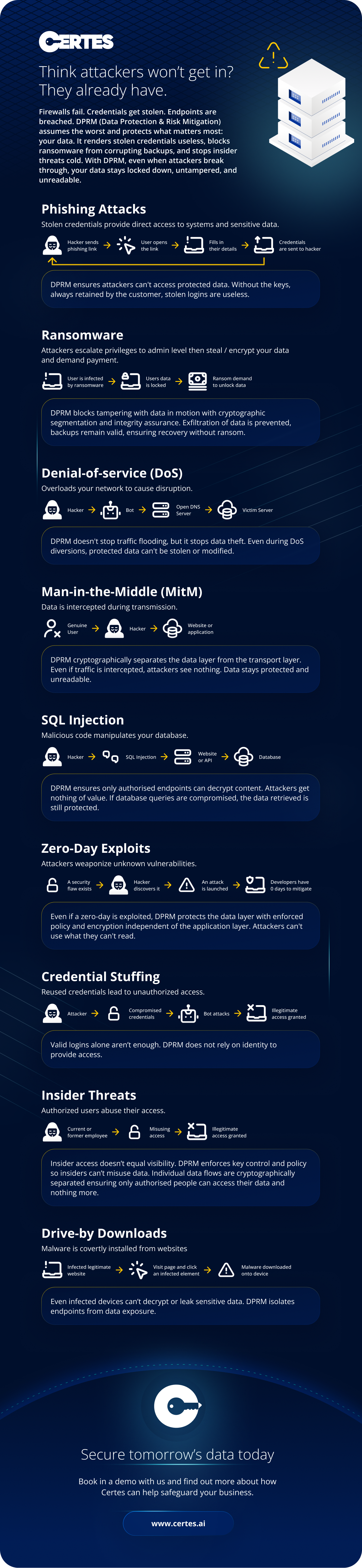
  • Think Attackers Won't Get In? They Already Have

    Infographic

    Think Attackers Won't Get In? They Already Have

    Firewalls fail. Credentials get stolen. Endpoints are breached. Cyber attackers use a range of sophisticated techniques to steal what's most important to you: your data. Here, we explain some of the most common types of cyber attack, and how Certes' DPRM (Data Protection & Risk Mitigation) protects your data so even when attackers break through, your data stays locked down, untampered, and unreadable.

Ready to protect the data that matters?

Talk to Certes about protecting sensitive data today.

Reduce exposure now, while your wider security and cryptographic transformation continues.