The Hidden Cost of Holding Customer Data: Why CFOs Should Rethink Their Risk Approach

In holding customer data, you also hold the liability if it’s compromised. What if you could reduce this liability, without impacting your service delivery?

The Hidden Cost of Holding Customer Data: Why CFOs Should Rethink Their Risk Approach

What’s the real cost of holding customer data?

Most organisations rightly treat data as an asset; a fuel for growth, personalisation, and service delivery. But how often do boards stop to ask: what if this “asset” is also the single biggest liability on our books? What if the customer information we’re holding today is the very thing that could bankrupt us tomorrow?

Because when you hold sensitive data, you also hold the financial liability if it’s compromised. And regulators don’t care whether the breach came from your tech, your people, or your third-party provider. If the data is exposed, everyone pays.

But what if there was a way to significantly reduce this liability, without impacting your service delivery?

Data is financial risk capital

Regulations have tightened up on data protection rules and litigation. Under GDPR, fines can reach 4% of global revenue per breach. In 2021, Amazon was fined €886 million for GDPR violations. DORA and NIS2 add strict accountability for boards and executives, while CJIS enforces mandatory encryption key ownership for law enforcement agencies.

The costs don’t end with fines. The average total cost of ransomware recovery for UK organisations rose to $2.58 million in 2025. Add in litigation, lost contracts, and reputational fallout, and the real number can be far higher.

For CFOs, each piece of sensitive data represents potential financial exposure that could impact the organisation if it’s compromised

The hidden reserves draining profitability

Behind the scenes, regulators expect that if you’re holding sensitive data, you’re financially capable of covering the fallout of a breach. That means CFOs need to plan for the potential financial impact of data breaches, including fines, litigation, and reputational costs. Organisations with larger data holdings may face proportionally higher exposure, which can strain profitability if not carefully managed

Shared liability: you can’t contract your way out

One of the most dangerous misconceptions in the boardroom is that liability can be outsourced. It can’t.

GDPR, DORA, and NIS2 make it clear: responsibility is shared across data processors. If your service provider, cloud partner, or contractor mishandles data, you’re still accountable. Regulators won’t stop at the weakest link; they’ll fine everyone in the chain.

This means one breach can multiply into several regulatory actions. And no contract clause will save you.

Why cybersecurity spending doesn’t fix the problem

Boards often assume that spending more on cybersecurity reduces financial liability. But that isn’t how regulators see it.

Attackers aren’t breaking in; they’re logging in with stolen credentials. Even the most sophisticated firewalls and monitoring can’t prevent exposure once access is gained. When data is compromised, regulators don’t care how many layers of defence you bought. They only care that you held it, and you lost it.

Cybersecurity tools can slow attackers down. They do nothing to shrink the liability of holding data. If you can see it, you can lose it. And if you can lose it, you’re financially exposed.

The alternative: eliminate liability at the source

The radical but logical answer is simple: don’t hold what you don’t need.

For decades, companies assumed that to deliver a service, they had to see and store customer data. That assumption is what created today’s liability trap. But technology has moved on. Data can now be protected in transit in a way that keeps it functional for the business while remaining inaccessible to the business itself.

If your systems can function without ever seeing or accessing sensitive data, you remove liability entirely. You can process, transmit, and deliver outcomes, but without the exposure that triggers regulatory fines.

No access means no exposure. And no exposure means no reserve required.

This shifts the equation for CFOs. Instead of carrying risk reserves that drain profitability, you can redesign operations so the liability is reduced in the first place.

Why the time to act is now

Regulatory penalties aren’t slowing down; they’re escalating. GDPR fines now run into the hundreds of millions. DORA and NIS2 explicitly make boards and executives personally accountable. And quantum computing threatens to break today’s protection methods, exposing encrypted data already stored today.

And here’s the part too many CFOs overlook: liability is shared. Under GDPR and related regulations, you cannot contract your way out of responsibility. If your third-party provider mishandles data, you’re still on the hook. One breach can mean multiple fines across the same data chain.

When you can access sensitive data, risk reserves balloon, margins erode, and profitability becomes hostage to regulators.

CFOs can’t afford to treat this as tomorrow’s problem. The question is whether boards act now to eliminate liability at the source or wait until the regulator, the attacker, or the market forces the issue.

Because the strongest companies in the next decade won’t be those with the biggest reserves. They’ll be the ones with the least to lose.

Go deeper

Practical resources on this subject.

Browse all resources
  • Executive Liability Is Real: Why Data Protection Now Sits in the Boardroom

    Blog

    Executive Liability Is Real: Why Data Protection Now Sits in the Boardroom

    If your organization mishandles sensitive data, regulators will knock on the boardroom door – and you could be personally liable. It’s time to stop securing the castle and start protecting the crown jewels: your data.

    Feb 2026

  • Why Your Cybersecurity Strategy Is Failing Where It Matters Most

    Blog

    Why Your Cybersecurity Strategy Is Failing Where It Matters Most

    If your business still believes perimeter defenses will protect it from a breach, you're already exposed. Most security strategies are focused on the wrong target, and it’s costing companies millions in fines, downtime, and lost trust.

    Feb 2026

  • It’s the Most Wonderful Time of the Year… Unless You’re Hit by Ransomware

    Blog

    It’s the Most Wonderful Time of the Year… Unless You’re Hit by Ransomware

    Holiday season means peak revenue for retailers, and peak opportunity for ransomware gangs. With attacks spiking and downtime more costly than ever, protecting the perimeter isn’t enough. Certes DPRM secures data in transit across every system and partner, keeping transactions flowing and customer trust intact when it matters most.

    Nov 2025

  • Why Data Breach Damage Runs Deeper Than You Think

    Infographic

    Why Data Breach Damage Runs Deeper Than You Think

    The headlines cover the breach. But what really brings companies down happens beneath the surface—regulatory fines, executive fallout, customer churn, and shareholder lawsuits. Jaguar Land Rover lost £1.9 billion. M&S dropped £1 billion in market value. These go beyond the headlines; they’re business-ending events. Discover how DPRM can help reduce your risk, protect your data, and avoid becoming the next headline.

    Nov 2025

  • Boardroom Cybersecurity: Why Liability Has Shifted to Executives

    Blog

    Boardroom Cybersecurity: Why Liability Has Shifted to Executives

    There was a time when a data breach was an IT problem. Those days are gone. Today, cybersecurity has climbed the corporate ladder right to the top floor.

    Oct 2025

  • Why Your Service Provider’s Breach Is Your Problem

    Blog

    Why Your Service Provider’s Breach Is Your Problem

    Too many CFOs and CISOs still believe their service providers have security under control. They don’t.

    Oct 2025

  • The Hidden Cost of Holding Customer Data: Why CFOs Should Rethink Their Risk Approach

    Blog

    The Hidden Cost of Holding Customer Data: Why CFOs Should Rethink Their Risk Approach

    In holding customer data, you also hold the liability if it’s compromised. What if you could reduce this liability, without impacting your service delivery?

    Sep 2025

  • Scattered Spider: How Certes DPRM Could Have Broken the Attack Chain

    Blog

    Scattered Spider: How Certes DPRM Could Have Broken the Attack Chain

    We explain how Certes DPRM would have neutralized the recent Scattered Spider retail ransomware attacks, and why a new approach to data security is needed

    Aug 2025

  • How Service Providers Can Eliminate Data Liability Without Losing Functionality

    Blog

    How Service Providers Can Eliminate Data Liability Without Losing Functionality

    When businesses talk about performance, the conversation is usually about uptime, speed, and scalability. But none of that matters when trust is broken. When customer data is exposed, systems are breached, and liability lands squarely on your balance sheet.

    Jun 2025

  • Why Your Firewall Can’t Stop a Lawsuit: The Real Risk of Ignoring Data Protection

    Blog

    Why Your Firewall Can’t Stop a Lawsuit: The Real Risk of Ignoring Data Protection

    Cybersecurity strategy has typically revolved around a single principle for too long: keep the bad guys out.

    Jun 2025

  • Data Poisoning: The Hidden Threat That Could Kill Your AI

    Blog

    Data Poisoning: The Hidden Threat That Could Kill Your AI

    AI is only as good as the data it learns from, and attackers are already exploiting that fact. Data poisoning is quickly becoming one of the most dangerous and least understood cyber threats facing organizations. While your security team focuses on perimeter defenses, attackers are poisoning the data your AI relies on – without ever needing to break into your systems. But what Is Data Poisoning? And Why Should You Care?

    Apr 2025

  • Data Is the Target: Why Perimeter Security Alone Is Not Enough

    Blog

    Data Is the Target: Why Perimeter Security Alone Is Not Enough

    Ransomware recovery is costly, and the reputational damage that follows can be irreparable. And it’s not just companies paying the price – executives face personal liability for failing to protect sensitive data. So why do so many businesses continue to rely on outdated network security models that focus solely on perimeter defenses?

    Feb 2025

  • Beyond Ransomware Payments: A Proactive Approach to Cybersecurity

    Blog

    Beyond Ransomware Payments: A Proactive Approach to Cybersecurity

    The UK government's recent proposal to ban public sector bodies – including the NHS, schools, and local councils – from making ransomware payments appears to send a strong message, but it only scratches the surface of what’s needed to counter these attacks.

    Jan 2025

  • Trust but Verify: Strengthening AI Security with Data Protection

    Blog

    Trust but Verify: Strengthening AI Security with Data Protection

    Research reveals an alarming vulnerability in AI systems, and their susceptibility to jailbreaking, highlighting the need to secure the data that underpins AI.

    Dec 2024

  • Breaking the Kill Chain: How DPRM Prevents Active Directory Breaches Before They Happen

    Blog

    Breaking the Kill Chain: How DPRM Prevents Active Directory Breaches Before They Happen

    Active Directory (AD) is a priority target for ransomware attacks. We explore why organisations need to adopt a new approach to protecting their systems. By breaking the kill chain, we can stop attacks in their tracks – protecting the data rather than relying solely on network-based defenses.

    Sep 2024

  • Rethinking Cybersecurity in Critical Infrastructure

    Blog

    Rethinking Cybersecurity in Critical Infrastructure

    The energy sector remains a prime target for cyber attackers seeking to disrupt global economies. Recent examples, such as the Halliburton incident, highlight how criminals can exploit vulnerabilities that persist in systems, like Active Directory (AD) – underscoring the urgent need for a shift in how we approach cybersecurity for critical infrastructure.

    Sep 2024

  • Once More into the Breach, Episode 2: The Critical Role of the C-Suite in Data Protection

    Video

    Once More into the Breach, Episode 2: The Critical Role of the C-Suite in Data Protection

    From GDPR to PCI compliance, regulatory bodies are tightening their grip, holding C-suite executives personally accountable for data breaches. With fines reaching millions and the spectre of potential imprisonment, the stakes have never been higher for both data protection and risk mitigation strategies.

    Jul 2024

  • Protecting Against ShinyHunters: Advanced Cyber Threats and DPRM Solutions

    Blog

    Protecting Against ShinyHunters: Advanced Cyber Threats and DPRM Solutions

    Cyber threats in data-rich industries are growing. A breach affecting 30 million at a financial firm by ShinyHunters highlights the need for robust Data Protection and Risk Mitigation solutions.

    Jul 2024

  • Going on the Offensive: Tackling Volt Typhoon Attacks Webinar

    Webinar

    Going on the Offensive: Tackling Volt Typhoon Attacks Webinar

    Simon Hill, VP North America and Lorilee Ressler, Solutions Architect provide an overview of the rising IT attacks on critical infrastructure operators and how Volt Typhoon continues to compromise systems all over the globe. They present the use case for how Typhoon attacks can be addressed and prevented as well as an overview on how

    May 2024

  • Ransomware Attacks on Active Directory: A Call to Action

    Blog

    Ransomware Attacks on Active Directory: A Call to Action

    In recent years, ransomware attacks surged, threatening businesses globally. A troubling trend is the targeted attack on Active Directory (AD), a crucial network component. We'll explore global ransomware attacks, tactics by groups like AlphaV/BlackCat and Volt Typhoon, shortcomings of traditional defenses, and introduce Certes DPRM as a proactive solution.

    May 2024

  • Understanding and Mitigating Volt Typhoon Attacks

    Blog

    Understanding and Mitigating Volt Typhoon Attacks

    Organisations worldwide are facing a new era of cyber threats, in recent months news has broke that numerous critical infrastructure operators have had their IT systems compromised by Volt Typhoon. We delve into the nuances of Volt Typhoon attacks, share the implications they can have for organisations and the practical strategies to adapt and innovate

    Mar 2024

  • The Legal Liability Dilemma

    Blog

    The Legal Liability Dilemma

    How do security leaders navigate the aftermath of a data breach? In the rapid pace of today’s digital landscape, data breaches have become an unfortunate reality for organisations worldwide. As these incidents continue to rise, a growing concern among security leaders, particularly Chief Information Security Officers (CISOs), revolves around their legal liability following such breaches.

    Jul 2023

  • Data Breach Accountability: Who Foots the Bill?

    Blog

    Data Breach Accountability: Who Foots the Bill?

    News stories about cybersecurity data breaches are sometimes difficult to avoid and even more difficult to digest. Data is increasingly valuable to businesses – especially data related to customers, payments and of a sensitive nature.

    Dec 2022

  • Active Directory Protection: Breaking the Ransomware Kill Chain

    Solution Brief

    Active Directory Protection: Breaking the Ransomware Kill Chain

    Certes provides a comprehensive approach to Active Directory protection, focusing on disrupting the ransomware "Kill Chain" at its most vulnerable point: privilege escalation and lateral movement. Data Protection and Risk Mitigation (DPRM) separates data access from network access, preventing lateral movement within the network and using quantum cryptography to secure sensitive information.

  • Volt Typhoon Attacks on Active Directory

    Whitepaper

    Volt Typhoon Attacks on Active Directory

    Volt Typhoons activities are challenging to identify and respond to due to the actor’s primary method of attack, “Living off the Land”, which leverages legitimate tools and functionalities already present within a compromised system or network to carry out malicious activities. Rather than relying on conspicuous malware or custom tools that may trigger security alerts,

  • Certes DPRM: Breaking the Kill Chain

    Infographic

    Certes DPRM: Breaking the Kill Chain

    This infographic breaks down the ransomware kill chain and shows how Certes’ Data Protection & Risk Mitigation (DPRM) solution disrupts attacks before they cause damage. By devaluing data with quantum-grade encryption, blocking privilege escalation, and preventing exfiltration, Certes renders stolen data useless – stopping ransomware in its tracks.

  • Breaching the Energy Sector: Protecting Critical Infrastructure Against Advanced Cyber Exploits

    Whitepaper

    Breaching the Energy Sector: Protecting Critical Infrastructure Against Advanced Cyber Exploits

    Sophisticated attacks like those on Halliburton show that organizations can no longer solely rely on perimeter-based security. A proactive, multi-layered defense is essential to thwart these evolving threats. DPRM can serve as a proactive defense mechanism, limiting attackers’ ability to exploit vulnerabilities like ZeroLogon, thereby ensuring the integrity and security of your organization’s critical assets.

  • Addressing the Critical Threat of ShinyHunters: How DPRM Can Protect Against Advanced Cyber Attacks

    Whitepaper

    Addressing the Critical Threat of ShinyHunters: How DPRM Can Protect Against Advanced Cyber Attacks

    The recent breach hitting a leading financial services company, affecting 30 million individuals, underscores the critical threat posed by sophisticated hacking groups such as ShinyHunters. This attack, part of a worrying trend, highlights the increased targeting of the financial services sector, which holds vast amounts of sensitive data. The hacker’s newsworthy breaches are a stark

  • Hope Is Not a Strategy: Rethinking Data Protection in the Age of Zero-Day Attacks

    Whitepaper

    Hope Is Not a Strategy: Rethinking Data Protection in the Age of Zero-Day Attacks

    The frequency of zero-day vulnerabilities is increasing, with 97 exploits in 2023, up from 62 in the previous year. Our whitepaper discusses the necessary shift in cybersecurity, emphasising the need to protect data against rising zero-day threats. It argues against relying solely on perimeter-based security and advocates for a proactive, zero-trust data access approach for

  • Certes for Federal Agencies

    Infographic

    Certes for Federal Agencies

    Federal systems are under relentless attack — from foreign adversaries, insider threats, and zero-day exploits. Even with cloud-first strategies, endpoint controls, and zero trust architectures, attackers are logging in — not breaking in. Certes DPRM protects what others can’t see.

  • Why Don't Companies Take Data Loss More Seriously?

    Whitepaper

    Why Don't Companies Take Data Loss More Seriously?

    Network breaches and Ransomware attacks are happening daily across all verticals and against both large and small companies, but why? Surely these companies are following the best practise and deploying the latest recommended network security and monitoring? When you map the rise in breaches against the introduction of technology designed to stop them we can see that the traditional approach of perimiter-based security measures is not working to stop or even slow the rate of breaches.

  • Why Data Security Is More Important Than Network Security

    Whitepaper

    Why Data Security Is More Important Than Network Security

    The realisation that data security is the most critical aspect of cybersecurity is now a staple - it’s now far more important than traditional network security. While network security plays a role in protecting the infrastructure, it is ultimately data that cybercriminals, insider threats, and nation-state actors are after. Securing the network without securing the data is like locking the doors but leaving the valuables unguarded.

  • Why Protecting Data Itself Is the Key to Defeating Zero-Day Attacks

    Whitepaper

    Why Protecting Data Itself Is the Key to Defeating Zero-Day Attacks

    In today’s digital age, cybersecurity threats are evolving at an unprecedented pace, with zero-day attacks standing out as some of the most formidable challenges for security professionals. While network monitoring tools play a crucial role in detecting anomalies and responding to known threats, they are fundamentally incapable of providing full protection against data loss stemming from zero-day attacks

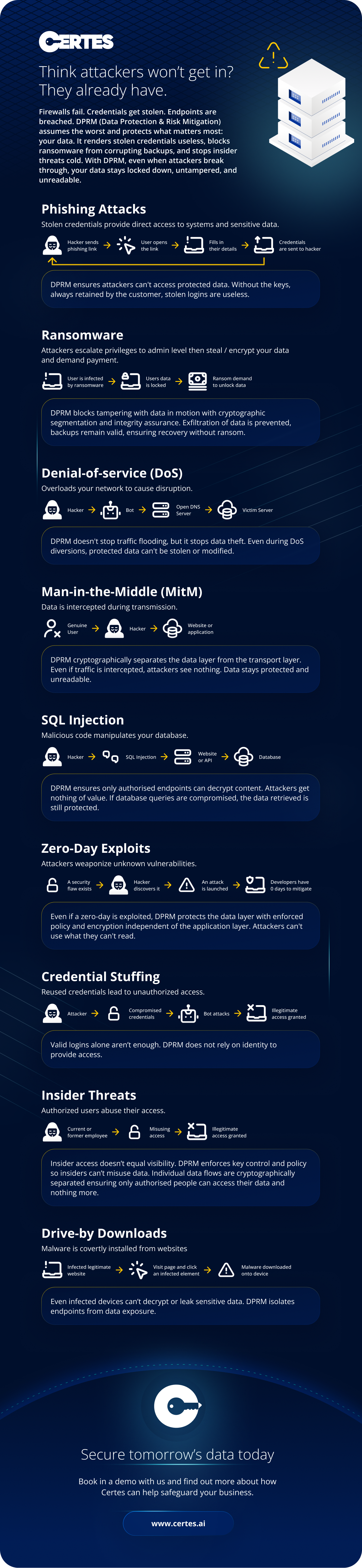
  • Think Attackers Won't Get In? They Already Have

    Infographic

    Think Attackers Won't Get In? They Already Have

    Firewalls fail. Credentials get stolen. Endpoints are breached. Cyber attackers use a range of sophisticated techniques to steal what's most important to you: your data. Here, we explain some of the most common types of cyber attack, and how Certes' DPRM (Data Protection & Risk Mitigation) protects your data so even when attackers break through, your data stays locked down, untampered, and unreadable.

Ready to protect the data that matters?

Talk to Certes about protecting sensitive data today.

Reduce exposure now, while your wider security and cryptographic transformation continues.